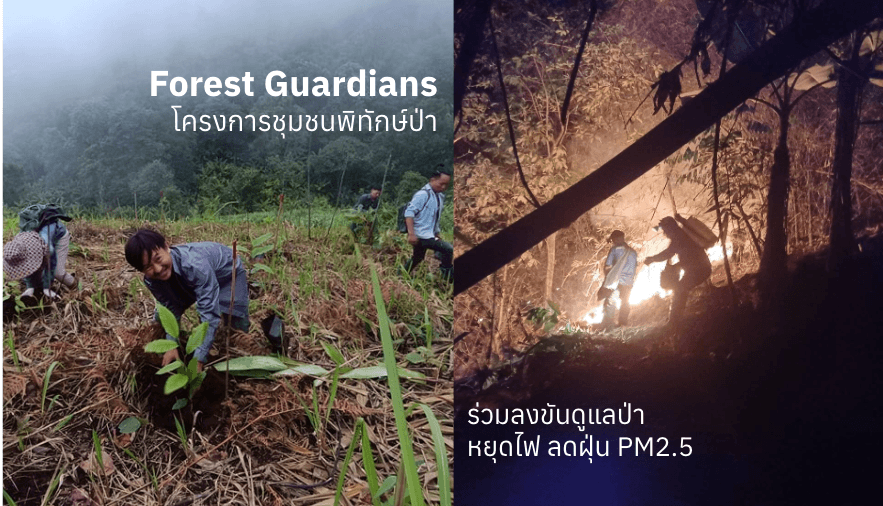
Forest Guardians
 Change Fusion
Donations for the project will support the budget,knowledge/skills for local villagers in watershed forest area to help monitor, and restore the forests on behalf of the downstream communities10communities in total.
Period of time
Jan 31, 2025 - Dec 31, 2026Location
SDG Goals
Beneficiary groups of the project
Fighting Wildfires and PM2.5 Pollution
Combat forest fires and toxic PM2.5 dust by supporting upstream villagers to monitor, maintain, and restore the forests on behalf of the downstream population.
Last year, communities supported in Chiang Mai were able to reduce their burned areas by 70%. When local villagers prevent wildfires and encroachment, it helps ensure we have clean air, water availability, flood prevention, and beautiful natural spaces for us and our loved ones to visit for recreation and mental well-being.
Therefore, supporting this project is a form of Payment for Ecosystem Services (PES), achieved by empowering communities to become Forest Guardians through scientifically measurable outcomes. This includes using satellite data to track burn scars, monitor forest cover (ensuring no loss), measure forest health/vigor ($\text{NVDI}$), and survey biodiversity.
Social issues
Fighting PM2.5 and Wildfires: The Need for Forest Guardians
The crisis of PM2.5 toxic haze and wildfires is constantly escalating, causing loss of life and injuries to people and wildlife. Over 3 million rai of forest are burned every year across Thailand, with $65\%$ of nationwide burn areas originating from wildfires—a major source of the PM2.5 that severely damages public health, leading to lung cancer and respiratory diseases.
The Challenge and the Solution (Payment for Ecosystem Services - PES)
With a total of 102 million rai of forest nationwide, government capacity alone is insufficient. Local upstream communities have voluntarily worked alongside officials to protect, prevent, extinguish fires, and reforest annually, often with little external support. Despite this, their actions directly benefit the quality of life for downstream urban populations.
This led to the creation of the Forest Guardian Community Project, aimed at providing these communities with the resources and tools necessary to manage the hundreds or thousands of rai of forest surrounding their villages.
Success Stories and Project Expansion
There are numerous examples of villages successfully becoming forest guardians. In 2024, support for communities like Ban Mae Sa Noi and Ban Pong Khrai (who manage thousands of rai of vital watershed forest in Doi Suthep-Pui National Park) led to tangible results. The communities formed intergenerational teams to build tens of kilometers of firebreaks, conducted three months of fire surveillance, and jointly tackled fires with officials, ultimately reducing the burned area by over $70\%$. They established local fire management rules, planted fire-resistant native trees for natural firebreaks and biodiversity, and developed forest-care-based economic activities to reduce reliance on external funding.
Building on this success, the project is expanding to support dozens more communities in 2025 to prepare for the upcoming wildfire season (March through the rainy season). This proactive approach aims to mitigate the risk of severe fires, like the unprecedented blazes seen in California, which are fueled by the global climate crisis.
Addressing Conflict and Promoting Sustainable Livelihoods
The challenge is compounded by the fact that many forest communities lack legal rights to manage their ancestral lands, often predating the declaration of forest and park boundaries. This sense of injustice can lead to conflicts, which sometimes result in deliberately set fires.
To address this, the project partners with a Chiang Mai University research team to resolve land conflicts and manage land tenure rights under new laws (e.g., Community Forest Law and National Park Act Section 19 and 65). This creates a permanent incentive for communities to generate income while protecting the forest through sustainable agriculture and eco-restoration tourism. This new income replaces fire-dependent farming, reduces hunting and foraging using fire, and ultimately makes the community self-sufficient in managing their forests without needing external funding. These economic development activities are supported after the fire season to ensure sustainable solutions.
Project Management and Partners
The project is a collaborative effort managed by ChangeFusion Institute under the Thai Rural Reconstruction Foundation and includes the following partners: Chiang Mai Breath Council Foundation, Northern Sustainable Development Foundation, Hug Muang Nan Foundation, Taejai, CMU PM2.5 Forestry Research Project, Thailand Institute of Justice, The Next Forest, FORRU, the Government Open Sub-Committee (under the Office of the Public Sector Development Commission), and The Centre for Humanitarian Dialogue ($\text{HD}$).
Approaches to addressing issues
Support communities with the potential to act as forest guardians by providing them with the necessary budget, knowledge, and technology/tools for forest protection, management, and restoration. This includes establishing mentor organizations to provide ongoing support and problem-solving, as well as facilitating access to government support and resources.
Foster a sustainable 'green economy' within forest-guarding communities that balances livelihood with conservation. Key initiatives include eco-tourism, regenerative, zero-burn agriculture, and carbon credit-based forest management. By dedicating a share of these revenues to a community environmental fund, we can empower local groups to effectively manage forest fires and restore nature independently and sustainably.
Integrate community-based forest conservation with government agencies and policies, particularly through local and provincial mechanisms. This aims to create a cohesive framework that ensures mutual recognition, institutional support, and collaborative action.
Integrate advanced scientific and technological tools for accurate monitoring. We will employ satellite remote sensing to track burnt areas and map forest perimeters, while evaluating forest health through NDVI metrics and validating data with comprehensive field-based biodiversity assessments.
Operational Plan
Select communities that demonstrate commitment and proven results in managing the forest areas around their locality, especially those working as part of a network with civil society organizations, universities, and forestry/national park agencies.
Here is the concise version of the plan for developing sustainable forest guardianship: Collaborate with Mentor Organizations (NGOs/universities) to help communities develop clear, data-driven, and transparent sustainable forest guardianship plans. The comprehensive plan focuses on four areas: 1.Maintenance: Activities like firebreaks, fire watch, and fire confrontation. 2.Restoration: Forest recovery and water management (e.g., creating wet forests). 3.Sustainable Economy: Transitioning to no-burn/regenerative agriculture and developing eco-restoration tourism. 4.Social Development: Enhancing community organization, governance/transparency, and reconciliation processes.
Select and support proposed community projects by prioritizing urgent activities, such as wildfire prevention and management. Once these initial activities achieve tangible results, further support will be considered for activities that restore natural, economic, and social capital within the Forest Guardian communities to ensure long-term sustainability.
Monitor progress and clearly measure results, in collaboration with mentor organizations and academic partners, including both: Ecological outcomes using scientific indicators (e.g., forest cover, fire impact, biodiversity). Socio-economic outcomes (e.g., community income, social capital development).
Present results and summarize lessons learned annually. At the end of each year, an event will be held for knowledge exchange and reflection among the participating communities and for the overall project. This aims to facilitate the learning of effective methods and solutions across different communities and to serve as a foundation for developing the next phase of the project.
Budget Plan
| Item | Quantity | Amount (THB) |
|---|---|---|
| Cost for Wildfire Prevention and Management Equipment, tools, and expenses for fuel/food required for creating firebreaks, fire watch duties, and fire suppression. | 5Communities | 200,000.00 |
| Cost for Social Capital Development Establishing management systems, planning, data development, developing transparent financial/reporting systems, and setting community rules for forest care and utilization. | 5Communities | 150,000.00 |
| Cost for Forest Restoration (Selected Communities) Supplemental planting and restoration, planting native fire-resistant trees as natural firebreaks, and care/monitoring for at least two years to ensure high survival rates. | 5Communities | 125,000.00 |
| Cost for Developing Nature-Restorative Economy (Selected Communities) Adjusting agricultural areas, developing eco-tourism, and supporting the establishment of community enterprises. | 5Communities | 50,000.00 |
| Support Cost for Mentor Organizations On-site visits, meetings to support community planning, monitoring, and assisting in the preparation of basic progress reports for each community. | 5Organizations | 500,000.00 |
| Cost for Measurement, Evaluation, and Project Coordination Expenses for scientific data collection (e.g., satellite/drone data, preliminary biodiversity surveys, etc.) and overall project coordination and monitoring. | 1Process | 250,000.00 |
| Wildfire Prevention and Response Management (Northern Thailand) Firebreak construction,Forest fire surveillance,Wildfire response,Insurance coverage for volunteer firefighters | 5Communities | 150,000.00 |
| Strengthening Grassroots Economy for Community Forest Conservation and Restoration (Northern Thailand Developing Local Resource-Based Products and Eco-Tourism for Community-Based Learning | 5Communities | 500,000.00 |
| Organizing Meetings and Conducting Field Visits to Monitor Community Project Progress | 12months | 120,000.00 |
| Monitoring Ecological Changes from Wildfire Management using Satellite and Drone Technology. | 10Communities | 150,000.00 |
| Tracking Social Impact, Grassroots Economic Metrics, and Community-Based Management. | 10Communities | 125,000.00 |
| Preparation of Quarterly Project Progress Reports and Comprehensive Project Performance Reports based on ESG (Environmental, Social, and Governance) Principles | 10Communities | 100,000.00 |
| Project Coordination and Management | 12months | 420,000.00 |
| Total Amount | 2,840,000.00 | |
| Taejai support fee (10%) | 284,000.00 | |
Project manager
Change Fusion
Create a fundraising page
Collaborate to fundraise in support of this project
Create a fundraising page